
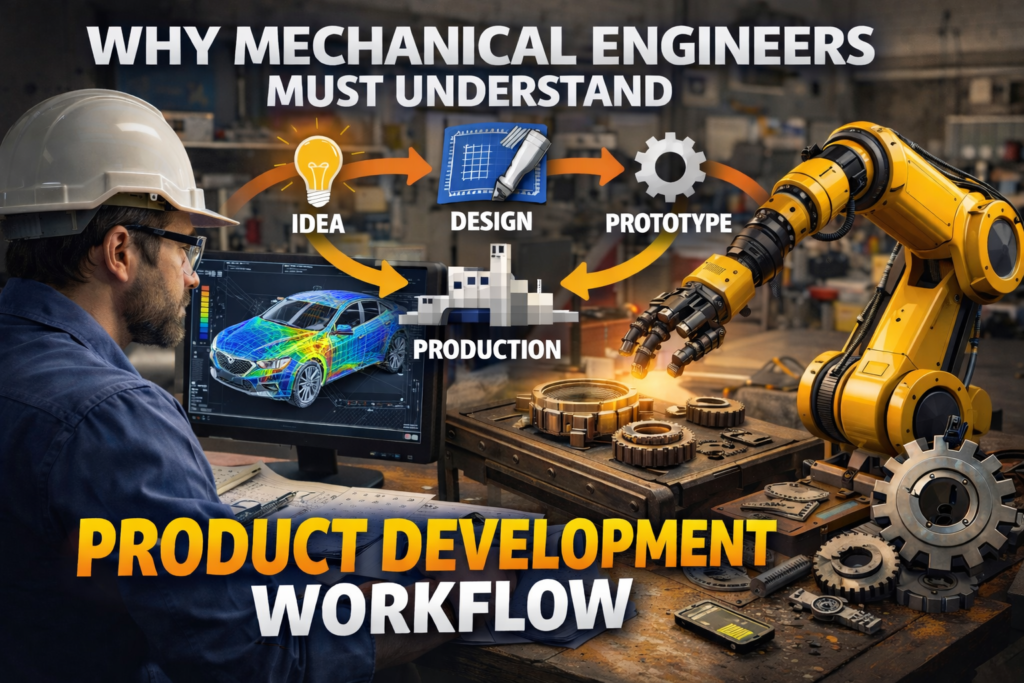
Why Mechanical Engineers Must Understand Product Development Workflow
Most mechanical engineers graduate with strong theoretical knowledge—but very limited understanding of how real engineering actually works inside the industry.
This gap becomes clearly visible in the first job.
Freshers are not just expected to use tools like CAD or CAE—they are expected to contribute to product decisions, understand engineering logic, and solve real-world problems.
To grow faster in your career, understanding the end-to-end product development workflow is not optional—it’s essential.
The Reality of Industry Engineering
In real-world companies—whether it’s automotive, aerospace, EV, or heavy engineering—products are not designed in isolation.
Every component goes through a structured engineering workflow, where each stage is interconnected:
- Design decisions affect simulation
- Simulation affects manufacturing
- Manufacturing affects cost and performance
If you don’t understand this flow, you will only remain a tool user—not an engineer.
Step-by-Step Product Development Workflow
1. Requirement Gathering
Every product starts with a clear understanding of:
- What the product must achieve
- Functional requirements
- Constraints (cost, weight, safety, regulations)
- Customer expectations
This stage defines the engineering problem statement.
2. Concept Design
Once requirements are clear, engineers move into:
- Idea generation
- Initial sketches
- Feasibility studies
This is where engineering thinking begins—multiple concepts are evaluated before selecting the best approach.
3. CAD Development
The selected concept is converted into a detailed 3D model using CAD tools.
Here, engineers define:
- Dimensions and tolerances
- GD&T (Geometric Dimensioning & Tolerancing)
- Assembly structure
- Manufacturing intent
CAD is not just drawing—it is the foundation of product definition.
4. CAE Simulation (Core of Modern Engineering)
Before any physical prototype is built, engineers validate designs using CAE (Computer-Aided Engineering).
This includes:
- Structural analysis
- Thermal analysis
- Crash simulation
- NVH (Noise, Vibration, Harshness)
- Fatigue and durability
- Multiphysics simulations
These simulations directly influence:
- Design modifications
- Material selection
- Weight optimization
- Safety and performance
CAE is where engineering decisions become data-driven.
5. Prototyping & Testing
After simulation, physical prototypes are built and tested.
Key objective:
Compare real-world results with CAE predictions
- If results match → design is validated
- If not → redesign and refinement
This step ensures simulation accuracy and product reliability.
6. Manufacturing Engineering
Once the design is validated:
- Tooling is developed
- Manufacturing processes are defined
- Quality control systems are implemented
This stage ensures the product can be produced efficiently, consistently, and at scale.
7. Validation, Release & Mass Production
Final stage includes:
- Product validation
- Certification and compliance
- Design release
- Mass production
Now the product is ready for the market.
Why This Workflow Matters for Mechanical Engineers
Understanding the complete workflow helps engineers:
- Make better engineering assumptions
- Improve communication across teams
- Avoid repeated design mistakes
- Connect CAD with CAE and real-world performance
- Take ownership of engineering decisions
The Difference Between Average & High-Growth Engineers
Engineers who only know tools:
- Work on isolated tasks
- Follow instructions
- Grow slowly
Engineers who understand workflow:
- Think like product engineers
- Solve problems, not just models
- Contribute to decisions
- Grow faster in OEMs and Tier 1 companies
ELENO Perspective
At ELENO Engineering Learning Center, we focus on building engineers who understand complete product development—not just software.
Our CAE training programs are designed to:
- Connect physics + CAD + CAE + real industry workflow
- Work on real engineering projects
- Build decision-making ability
- Prepare engineers for automotive, EV, and core engineering roles