Introduction: The EV Shift is an Engineering Opportunity, Not a Threat
The rise of the Electric Vehicle (EV) industry is transforming mobility at a global level. While many believe EVs reduce opportunities for mechanical engineers, the reality is the exact opposite.
The transition from traditional vehicles to EVs is not eliminating mechanical engineering roles — it is redefining and expanding them.
Today, companies are actively looking for engineers skilled in CAE (Computer-Aided Engineering), thermal systems, structural analysis, and multiphysics simulations.
Battery Systems: The Core of EV Engineering
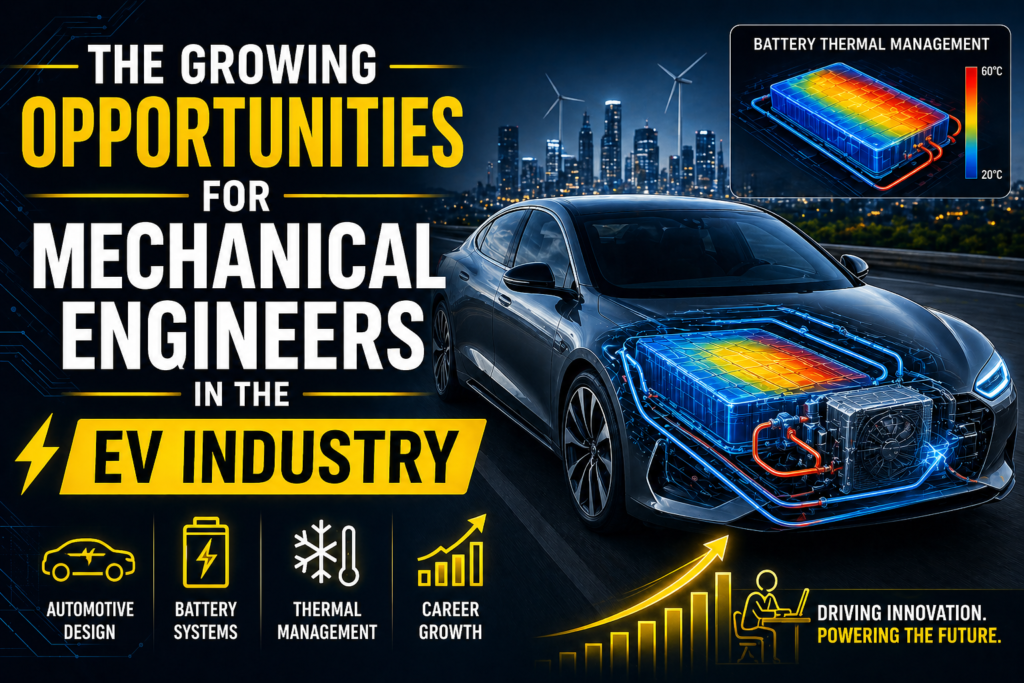
Battery technology is at the heart of every EV, and it has opened up multiple high-value roles for mechanical engineers.
Key areas where mechanical engineers contribute:
- Thermal management (battery cooling systems)
- Structural integrity of battery packs
- Crash safety and impact resistance
- Battery enclosure design
- Vibration and durability analysis
Engineers with expertise in FEM (Finite Element Method) and thermal simulations are highly in demand for:
- Battery cooling optimization
- Pack durability studies
- Fire and thermal runaway analysis
This is where CAE tools like LS-DYNA, Hypermesh, and ANSYS play a critical role.
Body-in-White (BIW): Still a Mechanical Engineering Backbone
Even in EVs, the vehicle structure remains a core mechanical domain.
EVs introduce new challenges such as:
- Increased battery weight
- Need for lightweight structures
- Advanced material usage
- Enhanced crash safety requirements
Mechanical engineers work on:
- Crashworthiness simulations
- Durability and fatigue analysis
- NVH (Noise, Vibration, Harshness) optimization
BIW engineering in EVs is becoming more complex and simulation-driven, not less.
Motors & Powertrain: Simpler, Yet Technically Demanding
Although EV powertrains are simpler compared to IC engines, they still require strong mechanical expertise.
Mechanical engineers are involved in:
- Thermal management of motors
- Acoustic and vibration analysis
- Mechanical design and packaging
- Manufacturing and material selection
The focus has shifted from complexity to precision, efficiency, and thermal performance.
Simulation-First Engineering: The Rise of CAE
One of the biggest shifts in the EV industry is the move toward simulation-driven product development.
EV startups and OEMs are adopting:
- Reduced physical prototyping
- Faster design iterations
- CAE-led validation processes
This has created massive demand for CAE engineers skilled in:
- Crash analysis
- Durability simulations
- Thermal analysis
- Multiphysics modeling
Engineers who understand simulation + physics are leading this transformation.
Skills Mechanical Engineers Must Learn to Enter the EV Industry
To stay relevant and future-ready, mechanical engineers must upgrade their skills in:
- CAE tools (LS-DYNA, Hypermesh, ANSYS)
- Multiphysics simulations
- Thermal engineering
- Crash & durability analysis
- Python automation for engineering workflows
- System-level engineering thinking
Conclusion: EV Industry is a Golden Era for Mechanical Engineers
The EV revolution is not reducing opportunities — it is creating a new generation of high-value engineering roles.
Mechanical engineers who adapt to:
- Simulation-driven workflows
- Advanced CAE tools
- Physics-based engineering
will not just survive — they will lead the future of mobility.
How ELENO Helps You Become EV-Ready
At ELENO Engineering Learning Center, we focus on building industry-ready CAE engineers through:
- Real-world EV and automotive projects
- Hands-on training in LS-DYNA, Hypermesh, and LSPP
- Physics-based learning approach
- Placement-focused programs
If you want to build a career in EV + CAE, ELENO helps you bridge the gap between college knowledge and industry skills.