
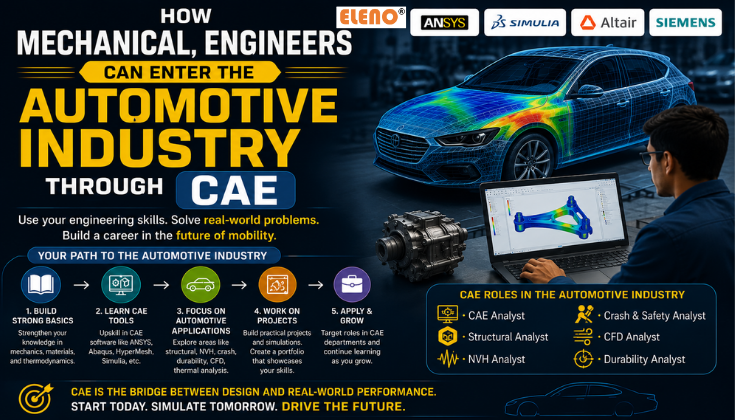
How Mechanical Engineers Can Enter the Automotive Industry Through CAE
The automotive industry is evolving faster than ever. From electric vehicles (EVs) and lightweight structures to advanced safety systems and smart manufacturing, companies are relying heavily on engineering simulation to develop better products in less time.
This transformation has created a massive demand for skilled CAE (Computer-Aided Engineering) professionals.
For mechanical engineers, CAE has become one of the strongest pathways into the automotive industry. Whether you are a fresher, final-year student, or working professional looking for career growth, learning CAE can open opportunities in OEMs, Tier-1 suppliers, EV startups, and simulation consulting companies.
In today’s automotive sector, companies are not only searching for engineers with theoretical knowledge — they need professionals who can solve real-world engineering problems using simulation tools and engineering physics.
What is CAE?
Computer-Aided Engineering (CAE) is the use of simulation and engineering software to analyze, validate, and optimize product designs before physical manufacturing begins.
CAE helps industries reduce:
- Development cost
- Prototype failures
- Testing time
- Product weight
- Manufacturing errors
In the automotive industry, CAE is widely used for:
- Crashworthiness analysis
- Durability analysis
- NVH analysis
- Thermal simulation
- Structural analysis
- Occupant safety
- Battery safety in EVs
- Manufacturing simulation
Why the Automotive Industry Depends on CAE
Modern vehicles are becoming more complex every year. Automotive companies must now achieve:
- Better safety ratings
- Improved fuel efficiency
- Lightweight vehicle design
- Faster product development
- EV battery protection
- Reduced emissions
Physical testing alone is expensive and time-consuming. That is why companies use CAE simulation to virtually test vehicle performance before production.
For example:
- A crash simulation can predict vehicle deformation during accidents.
- A thermal simulation can evaluate EV battery heating.
- Structural analysis can identify weak points in vehicle components.
This is why CAE engineers play a critical role in automotive product development.
Why Mechanical Engineers are Perfect for CAE
Mechanical engineering already provides the core foundation required for CAE.
Subjects like:
- Strength of Materials
- Engineering Mechanics
- Machine Design
- Finite Element Methods
- Thermodynamics
- Dynamics
- Manufacturing Processes
directly support simulation and analysis work.
A strong understanding of physics and engineering fundamentals allows mechanical engineers to interpret simulation results effectively rather than simply operating software.
In CAE, software knowledge is important — but engineering understanding is what makes a true simulation engineer.
Major CAE Domains in the Automotive Industry
1. Crashworthiness
Crashworthiness engineers analyze vehicle behavior during collisions to improve passenger safety.
Common applications:
- Frontal crash
- Side impact
- Roof crush
- Pedestrian safety
- Occupant protection
Popular software:
- LS-DYNA
- Hypermesh
- LSPP
Crash simulation is one of the highest-demand domains in automotive CAE.
2. Durability Analysis
Durability engineers ensure vehicle components can withstand long-term loading conditions.
Applications include:
- Chassis durability
- Suspension strength
- Fatigue life prediction
- Structural reliability
3. NVH Analysis
NVH stands for Noise, Vibration, and Harshness.
NVH engineers work on improving vehicle comfort and reducing unwanted vibrations and cabin noise.
This field is becoming increasingly important in electric vehicles because EVs are quieter than traditional vehicles.
4. Thermal & CFD Simulation
Thermal and fluid simulations are used for:
- Battery cooling
- HVAC systems
- Aerodynamics
- Heat transfer
- Airflow optimization
This domain is growing rapidly with EV development.
Skills Required to Enter Automotive CAE
Technical Skills
Mechanical engineers should develop knowledge in:
Software Skills
Industry-relevant software includes:
- Hypermesh
- LS-DYNA
- ANSYS
- Abaqus
- LSPP
- ANSA
Among these, LS-DYNA and Hypermesh are highly valued in crashworthiness and automotive safety simulation.
Engineering Fundamentals
Many students focus only on software tools. However, automotive companies prefer engineers who understand:
- Physics behind simulations
- Load paths
- Boundary conditions
- Failure mechanisms
- Material behavior
Strong engineering fundamentals help engineers solve complex real-world problems.
Career Opportunities in Automotive CAE
CAE professionals can work in:
- Automotive OEMs
- EV startups
- Tier-1 suppliers
- Aerospace companies
- Defense organizations
- Engineering consulting firms
Common job roles include:
- CAE Engineer
- Crashworthiness Engineer
- FEA Analyst
- Durability Engineer
- NVH Engineer
- Simulation Engineer
- Safety Engineer
Why the EV Industry is Increasing CAE Demand
Electric vehicles are creating new engineering challenges:
- Battery safety
- Lightweight structures
- Thermal management
- Structural integrity
- Crash safety
As a result, automotive companies are investing heavily in simulation-driven design and virtual validation.
This has significantly increased demand for skilled CAE engineers across India and globally.
Challenges Faced by Mechanical Engineers
Many mechanical engineering graduates struggle to enter the automotive industry because:
- Traditional academic learning lacks practical exposure
- Students have limited industry project experience
- Software training alone is often insufficient
- Core engineering concepts are not applied practically
To succeed in CAE, engineers need industry-oriented training combined with real simulation projects.
Building an Industry-Ready CAE Career
A successful CAE engineer develops:
- Strong engineering fundamentals
- Problem-solving ability
- Simulation expertise
- Industry project experience
- Understanding of automotive safety standards
Practical learning is extremely important because the automotive industry values application-oriented skills.
Working on real-time projects helps engineers understand:
- Complete simulation workflow
- Model preparation
- Solver setup
- Result interpretation
- Engineering decision-making
The Future of CAE in Automotive Engineering
The future of automotive engineering is becoming increasingly simulation-driven.
Emerging trends include:
- AI-assisted simulation
- Digital Twin technology
- Autonomous vehicle safety
- EV battery simulation
- Multiphysics analysis
- Cloud-based simulation
CAE will continue to play a major role in reducing development cost while improving vehicle safety and performance.
Mechanical engineers with strong CAE expertise will remain highly valuable in the evolving automotive industry.
Conclusion
CAE has become one of the most effective pathways for mechanical engineers to enter the automotive industry.
As vehicle technologies evolve, companies need engineers who can combine:
- Engineering fundamentals
- Simulation knowledge
- Problem-solving skills
- Real-world application understanding
Mechanical engineers who develop expertise in CAE can build strong careers in automotive safety, EV development, structural analysis, and advanced product engineering.
The automotive industry is rapidly moving toward virtual engineering and simulation-driven design — making CAE one of the most future-ready domains for mechanical engineers today.