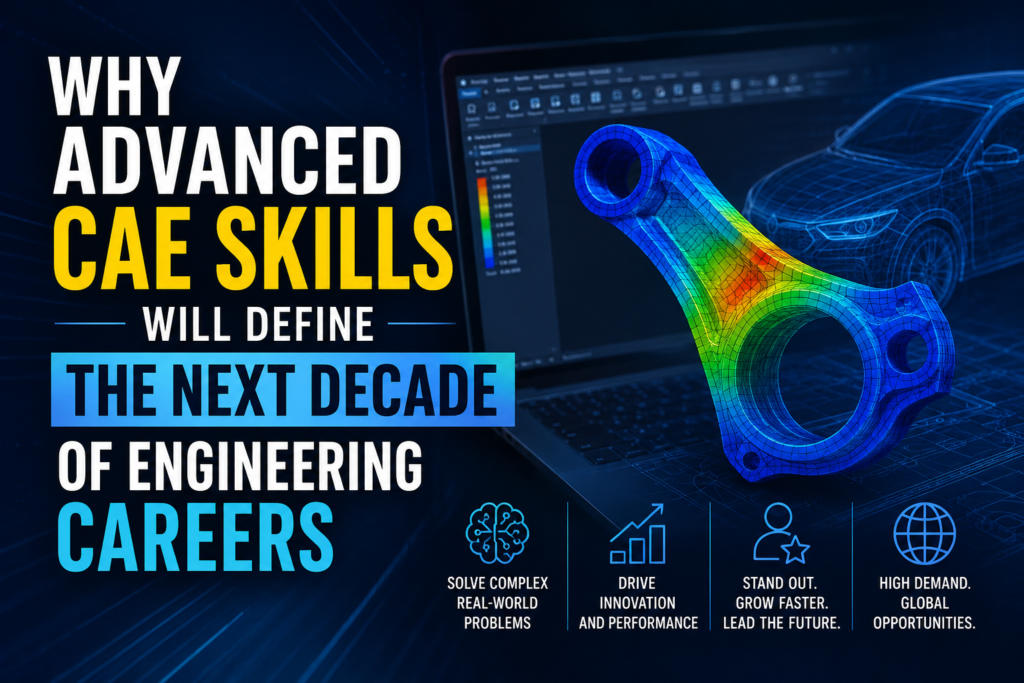
Why Advanced CAE Skills Will Define the Next Decade of Engineering Careers
“The future will not be built by guesswork. It will be built by simulation.”
Engineering has always been about solving real-world challenges through science, innovation, and problem-solving. But modern engineering problems are becoming more complex, expensive, and safety-critical than ever before. Industries can no longer rely only on physical testing and trial-and-error methods.
This is where Advanced Computer-Aided Engineering (CAE) is transforming the future of engineering.
Today, companies are not just looking for engineers who can design products — they need engineers who can simulate, predict, optimize, and validate performance before a product is physically manufactured.
Over the next decade, Advanced CAE skills will become one of the most valuable career assets for engineers across automotive, aerospace, defence, energy, railways, biomedical, and space technology sectors.
What is Advanced CAE?
Many students believe CAE only means basic stress analysis or finite element analysis (FEA). In reality, modern Advanced CAE is a highly specialized and rapidly evolving domain that includes:
- Crashworthiness Simulation using LS-DYNA and PAM-CRASH
- Durability and Fatigue Analysis
- NVH Analysis (Noise, Vibration, and Harshness)
- Thermal and CFD Simulations
- Explicit Dynamics and Impact Engineering
- Blast and Drop Test Simulations
- Multiphysics Simulations
- AI-Driven Simulation and Digital Twin Technologies
These technologies are now becoming essential for product development and engineering research.
Why CAE is Becoming the Backbone of Engineering R&D
Physical prototyping is expensive, time-consuming, and risky. Companies today need faster product development cycles while maintaining global safety and quality standards.
Advanced CAE enables industries to:
- Predict failures before manufacturing
- Reduce product development time significantly
- Test multiple design concepts virtually
- Optimize product weight, cost, and performance
- Improve safety compliance using virtual validation
- Minimize prototype and testing expenses
Industries worldwide are rapidly investing in virtual engineering because simulation reduces risk while accelerating innovation.
The Rise of the Modern CAE Engineer
The role of a CAE engineer has evolved dramatically.
Today’s CAE professionals are not simply analysts — they are critical problem-solvers who influence product safety, durability, and innovation.
At ELENO Centre of Excellence, we have seen mechanical engineering graduates transform into highly skilled simulation engineers working on:
- Electric vehicle crash safety
- Pedestrian protection systems
- Battery thermal management
- Aerospace structural simulations
- Defence impact analysis
- Rail safety and durability projects
These engineers directly contribute to safer and smarter technologies used by millions of people.
The demand for CAE engineers is increasing because their expertise combines:
- Strong engineering fundamentals
- Physics-based thinking
- Advanced software skills
- Real-world problem-solving ability
Why Engineering Students Must Learn CAE Early
Many engineering colleges still focus heavily on theoretical education with limited exposure to industrial simulation practices.
However, companies today prefer candidates who already understand:
- Finite Element Methods (FEM)
- Meshing and Pre-processing
- Simulation workflows
- Design validation techniques
- Industry standards and engineering regulations
Students who learn CAE during or immediately after graduation gain significant advantages:
Better Career Opportunities
CAE-trained engineers are highly preferred in R&D and simulation departments.
Stronger Interview Performance
Students with practical CAE project exposure perform better during technical interviews.
Faster Industry Adaptation
Simulation-trained engineers contribute to projects much earlier than traditional graduates.
Global Career Growth
Advanced CAE skills are in demand across international automotive, aerospace, and energy industries.
Future Trends Driving Massive Demand for CAE Engineers
The next decade will be dominated by industries that rely heavily on advanced simulations.
1. Electric Vehicle (EV) Revolution
EV development requires:
- Battery safety simulations
- Thermal management analysis
- Lightweight structural optimization
- Crashworthiness engineering
2. Smart Infrastructure & Urban Mobility
Modern transportation systems require:
- Crash barrier analysis
- Rail safety simulations
- Structural durability studies
3. Aerospace and Defence Expansion
Defence and aerospace sectors depend heavily on:
- Blast simulations
- High-impact analysis
- Fatigue and reliability prediction
4. Space Technology Growth
Space engineering increasingly demands:
- Shock analysis
- Thermal simulations
- High-temperature material studies
5. Digital Twins and AI-Integrated Simulation
The future of engineering will combine:
- Real-time simulation
- Predictive maintenance
- AI-driven optimization
- Virtual sensors and digital twins
All these emerging technologies require engineers with advanced CAE expertise.
A Message for Parents and Educators
Engineering careers are changing rapidly.
Today, career success is not only about getting a degree — it is about developing future-ready technical skills that remain valuable for decades.
If students from Mechanical, Civil, Electrical, or Electronics engineering backgrounds are introduced to CAE early, they gain:
- Better employability
- Long-term career stability
- Global engineering opportunities
- Stronger technical confidence
Parents and educators should encourage practical simulation learning alongside traditional academics.
How ELENO Centre of Excellence is Preparing Future Engineers
At ELENO COE, our mission is to bridge the gap between classroom education and real industrial engineering requirements.
We train students and professionals in:
- LS-DYNA
- HyperMesh
- Crashworthiness Engineering
- Durability & Fatigue Analysis
- Explicit Dynamics
- Industrial CAE Workflows
Our training philosophy focuses on creating engineers who are:
✅ Strong in engineering physics
✅ Skilled in industrial simulation tools
✅ Industry-oriented and project-ready
✅ Prepared for future engineering technologies
We believe the future engineer will not just design products — they will predict performance, improve safety, and drive innovation through simulation.
Final Thoughts
Advanced CAE is no longer an optional specialization. It is becoming the foundation of next-generation engineering.
As industries move toward virtual validation, AI-driven engineering, electric mobility, and digital twins, the demand for skilled CAE engineers will continue to grow rapidly.
The engineers who master simulation today will become the innovators, safety leaders, and technology experts of tomorrow.
The future belongs to engineers who can simulate before they build.
Contact ELENO COE
📞 Contact: 9881732144
🌐 Website: www.eleno-elc.com