
MIT-WPU Pune Hosts Hands-on CAE Workshop on EV Safety & Defence Simulation
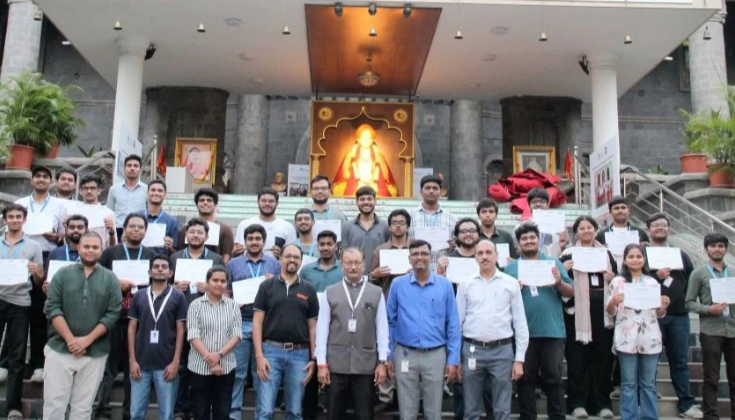
The Mechanical Engineering Students Association (MESA), Department of Mechanical Engineering at Dr. Vishwanath Karad MIT World Peace University (MIT-WPU), Pune, organised a three-day hands-on workshop titled “CAE Workshop – EV Safety & Defence Impact Simulation” from 7 to 9 October 2026, in association with ELENO, Pune. The workshop brought together 30 second- and third-year Mechanical Engineering students for an immersive technical learning experience focused on the practical applications of Computer-Aided Engineering (CAE) in electric vehicle safety, impact analysis, and defence engineering.
The workshop was conducted by Mr. Nachiket Phadke, Founder and CEO of ELENO, who brings over 20 years of industry experience in Computer-Aided Engineering and engineering simulation. Centred on the theme “Run Your First Drop & Bullet Simulation,” the programme aimed to bridge the gap between academic engineering concepts and industry practices. Through expert-led sessions and practical demonstrations, students were introduced to the fundamentals of CAE, computer-aided design, geometry preparation, meshing, solver execution, and post-processing of simulation results.
A major highlight of the workshop was the hands-on exposure to EV Battery Drop Test Simulation and Bullet Penetration Simulation for Defence Applications. Participants explored how simulation tools help engineers understand the behaviour of components and structures under impact loading. The sessions covered important concepts such as stress distribution, deformation, energy absorption, impact response, and material failure, helping students understand how engineering simulation contributes to product safety, reliability, and performance evaluation.
The EV battery simulation sessions introduced participants to the importance of evaluating battery structural integrity under impact conditions. Students gained insights into how virtual testing can help engineers identify potential failure zones, assess structural behaviour, and improve safety considerations during the product development process. The defence impact simulation sessions demonstrated the role of explicit dynamics analysis in understanding high-speed impact events and evaluating the response of materials and structures under demanding loading conditions.
Beyond technical learning, the workshop highlighted the growing importance of CAE across the automotive, electric vehicle, aerospace, and defence industries. Participants gained a broader understanding of how simulation-driven product development supports engineering innovation, reduces dependence on repeated physical prototypes, and enables informed design decisions. The programme also introduced students to potential career pathways in CAE, crashworthiness, structural analysis, EV battery safety, and advanced engineering simulation.
The programme was attended by Prof. (Dr.) Deepak Hujare, Programme Director; Prof. (Dr.) Ratnakar R. Ghorpade and Prof. Mahesh Pradhan, Programme Coordinators; and Dr. Ganesh Shrigandhi, Faculty Advisor, MESA. The workshop was coordinated by Dr. Ganesh Shrigandhi with the support of the MESA team, whose efforts contributed to the successful organisation of the programme and the facilitation of industry-oriented learning opportunities for students.
As part of the learning experience, participants received simulation resources, recorded sessions, mini-project assignments, career guidance, and participation certificates. These resources were intended to support continued learning beyond the workshop and encourage students to explore simulation-based engineering projects. The positive response from participants reflected the value of combining technical instruction with practical exposure to real-world engineering applications.
The workshop reinforced the importance of collaboration between academic institutions and industry in preparing future engineers for evolving technological demands. By bringing industry expertise into the academic environment, the initiative provided students with valuable insights into professional engineering workflows and the skills expected in modern simulation-driven industries.
Through its collaboration with MIT-WPU and MESA, ELENO continues to support practical engineering education, technical skill development, and industry-oriented learning. Initiatives such as this workshop help aspiring engineers move beyond theoretical knowledge, strengthen their understanding of advanced simulation techniques, and prepare for opportunities in EV safety, crash analysis, impact simulation, and defence engineering.
ELENO — Advancing Engineering Skills Through Simulation.