
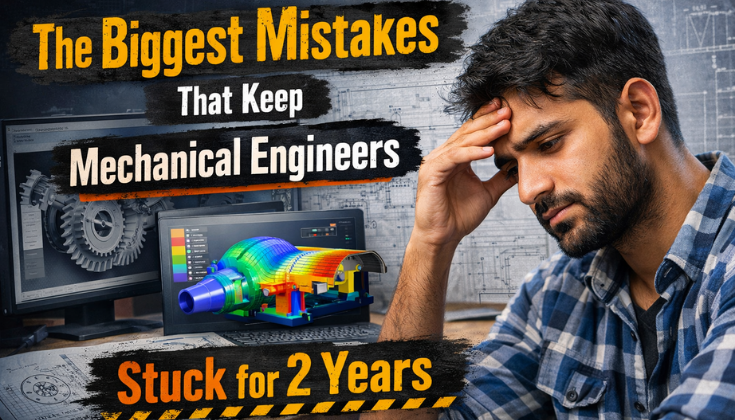
The Biggest Mistakes That Keep Mechanical Engineers Stuck for 2 Years
Many mechanical engineers struggle during their first one to two years after graduation. They often remain in low-paying roles or move completely outside core engineering. This does not happen due to lack of talent, but because of a few common and avoidable mistakes.
At ELENO-style learning, the focus is on clarity, strong fundamentals, and real engineering depth rather than shortcuts.
Depending only on CAD skills
Learning CAD is important, but relying only on it can limit growth. CAD has become a basic requirement, not a differentiator. Many engineers know 3D modeling, which makes it harder to stand out in the job market.
Skills like CAE, simulation, and multiphysics analysis are far more valuable. These skills help engineers solve real-world problems and are highly demanded by OEMs and Tier-1 companies. Moving beyond modeling opens better career opportunities.
Doing courses without building real projects
Many freshers complete multiple online courses and collect certificates, hoping they will lead to jobs. In reality, companies do not hire certificates—they hire engineers who can demonstrate their skills.
A few well-executed CAE or physics-based projects show real capability. Projects reflect understanding of loads, behavior, and engineering logic, which matters far more than course completion badges.
Weak fundamentals in core engineering subjects
Without strong basics in mechanics, strength of materials, and physics, software knowledge has little value. Tools only give results; understanding fundamentals helps you judge whether those results make sense.
Engineers with strong fundamentals can explain behavior, identify errors, and create meaningful analysis instead of just clicking buttons.
No professional presence on LinkedIn
Many engineers remain unnoticed simply because they are not visible. Without sharing your work, learning, or projects, recruiters and hiring managers cannot find you.
Posting regularly about engineering concepts, simulations, and project learnings helps build credibility and attracts opportunities naturally.
Lack of specialization and direction
Trying to learn everything at once often leads to confusion and average skills. Without a clear domain, growth becomes slow and confidence remains low.
Choosing a focused area such as crash analysis, durability, NVH, EV systems, or defence simulation gives direction and makes skill-building more effective.
Final thoughts
Mechanical engineers often feel stuck not because they lack effort, but because their efforts are misdirected. Focusing on strong fundamentals, real projects, advanced CAE skills, visibility, and specialization can reduce early-career struggle significantly.
Success in mechanical engineering comes from doing the right things with depth, consistency, and clear direction
.Build value, and salary will follow.
Your journey from core engineering to simulation begins with upskilling for the future. With 20+ years of industry experience,
Nachiket Phadke and the ELENO mentor team guide engineers toward industry-ready CAE careers.
📞 9881732144
🌐 www.eleno-elc.com