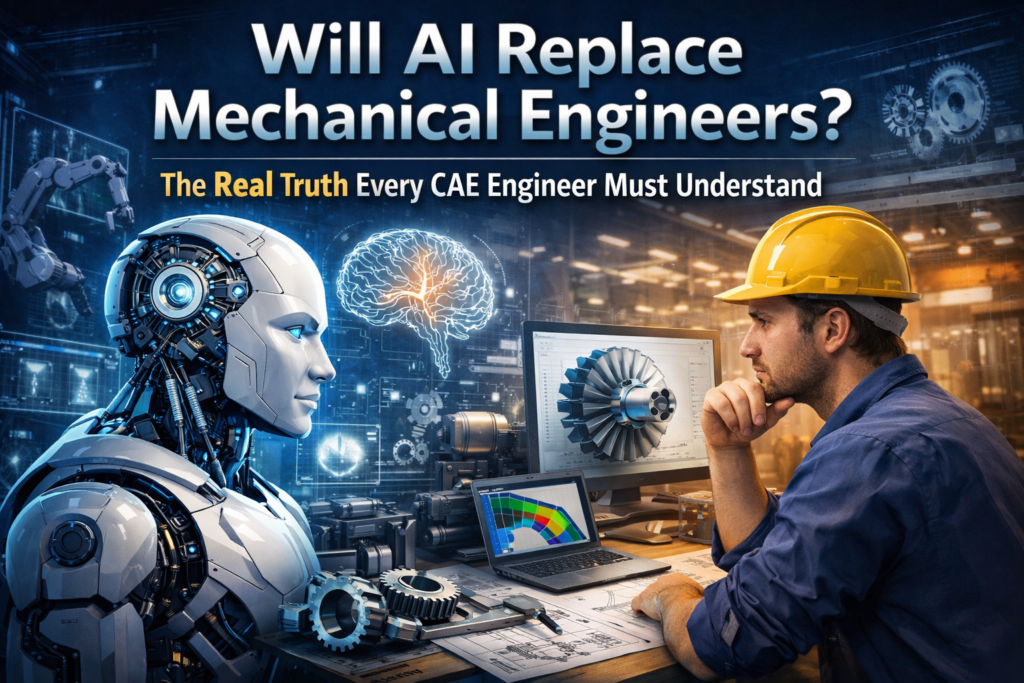
Will AI Replace Mechanical Engineers? The Real Truth
Artificial Intelligence is rapidly transforming the engineering landscape. From automated meshing and generative design to AI-assisted simulation and optimization, tasks that once took hours—or even days—can now be completed in minutes.
Naturally, this progress raises an uncomfortable question among mechanical engineers:
Will AI replace mechanical engineering jobs?
The honest and experience-driven answer is this:
AI will replace repetitive engineers, not real engineers.
Mechanical Engineering Is a Physics-Driven Profession
Mechanical engineering is not about software buttons or automation scripts. At its core, it is a physics-based discipline built on:
- Forces and motion
- Material behavior and failure
- Energy transfer
- Boundary conditions and constraints
- Nonlinearity and real-world uncertainty
AI can accelerate workflows, but it cannot reason the way a trained engineer does. It does not truly understand why a structure fails, why stress redistributes, or why a simulation result violates physical laws.
That reasoning comes from physics—not algorithms.
What AI Is Replacing
AI is extremely good at automating tasks that are:
- Predictable
- Rule-based
- Repetitive
- Low on engineering judgment
Examples include:
- Geometry cleanup
- Batch simulations
- Parameter sweeps
- Data organization
- Report generation
- Template-based preprocessing
These tasks were never engineering judgment to begin with. They were time-consuming support activities.
AI is simply doing what engineers have always wanted—removing drudgery.
What AI Cannot Replace
AI cannot replace engineers who understand:
- Why a model behaves a certain way
- Why a structure fails under specific loading
- Why a mode shape shifts after design change
- Which boundary conditions actually matter
- When simulation results violate physics
These engineers are not threatened by AI.
In fact, AI makes them 10× more powerful.
The Future Engineer: Human Judgment + AI Speed
The future mechanical engineer will not compete against AI—but will work with it.
A realistic workflow looks like this:
- AI suggests a mesh → Engineer verifies quality and physics
- AI predicts stress patterns → Engineer checks load paths and assumptions
- AI proposes a design → Engineer evaluates feasibility and manufacturability
- AI runs optimization → Engineer interprets trade-offs and risks
The role shifts from operator to decision-maker.
The Real Risk: Button-Click Engineers
The engineers most at risk are not mechanical engineers.
They are software operators—people who:
- Only know how to click menus
- Follow tutorials without understanding physics
- Depend entirely on tool defaults
- Cannot explain results beyond screenshots
These roles will disappear—not because of AI, but because better engineers using AI will replace them.
Where AI Gives Engineers a Massive Advantage
Engineers who embrace AI gain real, measurable advantages:
- CAE engineers use AI to accelerate preprocessing and postprocessing
- Python-skilled engineers automate repetitive simulation workflows
- Crash, battery, thermal, and defense engineers evaluate more design variants faster
- Multiphysics engineers reduce iterations and improve convergence
AI does not reduce engineering value.
It multiplies it.
Skills That Make Engineers Future-Proof
Mechanical engineers who remain indispensable will combine:
- Strong fundamentals in FEM and mechanics
- Deep understanding of physics-based modeling
- Python for automation
- Exposure to multiphysics and nonlinear simulations
- Familiarity with AI-assisted CAE workflows
This combination creates engineers who can:
- Ask the right questions
- Validate AI outputs
- Catch wrong assumptions
- Make safe, cost-effective design decisions
AI Is Not the Enemy — It Is an Amplifier
AI can calculate faster.
AI can process more data.
AI can suggest possibilities.
But only an engineer can:
- Interpret results
- Apply physics judgment
- Understand real-world constraints
- Take responsibility for decisions
AI calculates. Engineers decide.
Final Thoughts: Real Engineering Is Here to Stay
Mechanical engineering is not disappearing.
But the type of mechanical engineer the industry needs is changing faster than ever.
The future belongs to engineers who:
- Use AI as an assistant
- Trust physics over blind automation
- Build judgment, not just workflows
Those engineers will not just survive the AI era.
They will lead it.Your journey from core engineering to simulation starts with one step — upskilling yourself for the future.
With over 20 years of industry experience, our founder Nachiket Phadke and our mentor team guide learners through:
📞 Contact Nachiket: 9881732144
🌐 Visit: www.eleno-elc.com
At ELENO Engineering Learning Center, we believe strong physics fundamentals combined with modern CAE and AI-assisted workflows are the key to building future-ready engineers.