
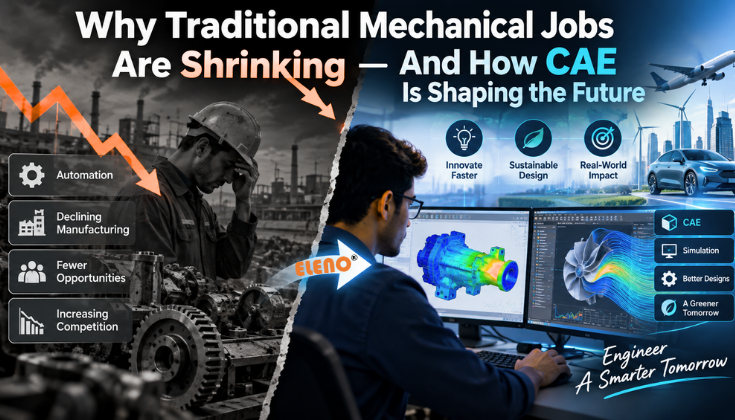
Why Traditional Mechanical Jobs Are Shrinking — And How CAE Is Shaping the Future
The Mechanical Engineering Career Landscape Is Changing
For decades, Mechanical Engineering was considered one of the safest and most versatile career choices. Manufacturing plants, automobile companies, design offices, and maintenance departments constantly needed mechanical engineers.
But the industry has changed.
Today, having a Mechanical Engineering degree alone is no longer enough to guarantee a strong career. Automation, artificial intelligence, digital engineering, and global outsourcing have transformed the way companies design, manufacture, test, and maintain products.
This does not mean Mechanical Engineering is dying.
It means the skills required from mechanical engineers are changing.
The industry is moving from traditional engineering roles toward engineers who can combine mechanical fundamentals with advanced digital engineering technologies.
One of the most important areas driving this transformation is Computer-Aided Engineering (CAE).
Why Are Traditional Mechanical Engineering Jobs Reducing?
Modern industries are continuously looking for ways to improve productivity, reduce costs, and shorten product development cycles.
Several technologies are contributing to this transformation.
1. Automation & Robotics
Manufacturing processes that once required large teams can now be performed using automated systems and robots.
This has reduced the requirement for engineers in repetitive and highly manual tasks.
2. Artificial Intelligence
AI is increasingly being used for predictive maintenance, optimization, quality control, and engineering decision-making.
Engineers are therefore expected to work with technology rather than compete against it.
3. Digital Engineering
Companies are moving toward virtual product development, where products can be designed, tested, optimized, and validated digitally before physical prototypes are created.
4. Globalization & Outsourcing
Routine CAD, drafting, documentation, and engineering support activities can be performed from engineering centres across the world.
As a result, companies increasingly value engineers who possess specialized and problem-solving skills.
The Opportunity: Engineering Is Moving Toward CAE
While some traditional roles are becoming more competitive, new engineering opportunities are emerging.
One of the strongest examples is Computer-Aided Engineering (CAE).
CAE allows engineers to use computer simulations to predict how a product will behave under real-world conditions.
Instead of depending entirely on physical prototypes, engineers can digitally investigate:
- Structural strength
- Crashworthiness
- Impact behaviour
- Durability
- Material deformation
- Occupant safety
- Thermal performance
- Fluid behaviour
- Product optimization
This is particularly important in the automotive industry, where safety and performance are critical.
Why Vehicle Crash Simulation Matters
Imagine developing a new vehicle.
Traditionally, engineers would need to build physical prototypes and conduct crash tests to understand how the vehicle behaves during an accident.
A physical crash test can destroy the vehicle and requires significant time, resources, and preparation.
With CAE, engineers can simulate crash scenarios digitally and study how the vehicle structure responds to impact.
Engineers can investigate questions such as:
Will the passenger compartment remain safe?
Where will the vehicle structure deform?
How will the energy be absorbed?
How can the structure be optimized?
How will occupants be protected during an impact?
This is where advanced crash simulation tools such as LS-DYNA, HyperMesh, and LSPP become extremely valuable.
From Physical Testing to Virtual Engineering
The objective of simulation is not simply to replace physical testing.
It is to enable engineers to test smarter.
A CAE engineer can evaluate multiple design concepts, identify potential problems early, optimize the structure, and support physical validation.
This helps companies reduce:
Prototype dependency → Development time → Engineering cost
while improving:
Safety → Performance → Design confidence
For automotive companies, this capability has become an essential part of modern vehicle development.
Increasing Vehicle Safety Is Creating New Opportunities
Vehicle safety requirements are becoming increasingly important across global automotive markets.
Standards and assessment programs such as Bharat NCAP, Euro NCAP, and US NHTSA requirements are pushing manufacturers to focus more strongly on vehicle safety and crash performance.
This creates a growing requirement for engineers who understand:
- Vehicle crashworthiness
- Structural behaviour
- Material mechanics
- Finite Element Analysis
- Impact mechanics
- Occupant safety
- Crash simulation
- Simulation model development
- Post-processing and result interpretation
The industry therefore needs engineers who can understand both physics and simulation technology.
The Biggest Problem: The Skill Gap
Here is where many Mechanical Engineering graduates face a challenge.
Engineering education provides the fundamental knowledge required to understand mechanics, materials, thermodynamics, manufacturing, and other engineering subjects.
But industry often requires something more.
Companies need engineers who can apply engineering knowledge using professional simulation tools.
A student may understand:
Stress, strain, deformation, energy absorption and material behaviour.
But an industry-ready CAE engineer must also know:
How to create the model, define the material, apply the required conditions, run the simulation, interpret the results, identify failure modes, and improve the design.
That difference is the industry skill gap.
This Is Where ELENO ELC Comes In
At ELENO ELC, the objective is not simply to teach software commands.
The goal is to develop industry-ready CAE engineers.
Our learning approach combines:
Mechanical Engineering Fundamentals
Understanding the physics behind the problem is the foundation of good simulation.
LS-DYNA Crash Simulation
Learn crashworthiness and impact simulation concepts through practical engineering applications.
HyperMesh
Develop skills in preprocessing, meshing, model preparation, and simulation setup.
LSPP
Understand how to visualize and interpret simulation results effectively.
AI for CAE
Explore how Artificial Intelligence can support the next generation of engineering simulation.
Physics-Driven Learning
Because knowing “how to run a simulation” is not enough.
A good CAE engineer must understand “why the simulation behaves the way it does.”
Learn From Industry Experience
At ELENO ELC, learners receive mentorship from Nachiket Phadke, who brings 19+ years of hands-on experience in crash simulation and automotive engineering.
This industry experience helps learners understand CAE beyond textbooks and software interfaces.
The focus is on developing engineers who can think like simulation engineers, not simply software operators.
What Career Opportunities Can CAE Open?
CAE expertise can create opportunities across multiple engineering sectors.
Automotive
- Crashworthiness
- Vehicle safety
- Structural simulation
- Occupant safety
- Impact analysis
Tier-1 Automotive Suppliers
- Seat systems
- Airbags
- Safety components
- Structural components
Aerospace & Defense
- Impact analysis
- Structural safety
- Crashworthiness
- Lightweight design
Engineering & Simulation Services
- CAE analysis
- Model development
- Simulation support
- Product optimization
The common requirement across these sectors is the same:
Engineers who can solve real engineering problems using simulation.
Why CAE Is More Than Just a Software Skill
One of the biggest misconceptions about CAE is that learning a software package alone makes someone a CAE engineer.
It doesn’t.
A strong CAE engineer needs a combination of:
Engineering Fundamentals + Physics + Simulation + Problem Solving + Industry Understanding
Software is the tool.
Engineering knowledge is what makes the tool valuable.
That is why ELENO ELC focuses on physics-driven learning instead of simply teaching commands and workflows.
The Future of Mechanical Engineering
The future mechanical engineer will not be limited to traditional design, manufacturing, or maintenance roles.
The industry is moving toward engineers who can work with:
- CAE
- AI
- Automation
- Digital Twins
- Advanced Simulation
- Optimization
- Virtual Product Development
This transformation creates a new opportunity for Mechanical and Automobile Engineers.
Instead of asking:
“Are mechanical engineering jobs disappearing?”
The better question is:
“Am I developing the skills that the new engineering industry needs?”
Don’t Prepare for the Past. Prepare for the Future.
Mechanical Engineering is not disappearing.
The definition of a Mechanical Engineer is changing.
The engineers who adapt to advanced technologies, understand engineering physics, and develop specialized CAE skills can position themselves for the opportunities created by this transformation.
If you’re a Mechanical or Automobile Engineering student, fresher, or working professional looking to build a career in advanced simulation, CAE can be the bridge between your engineering degree and the future of engineering.
Build the skills. Understand the physics. Master the simulation.
Learn CAE. Build your future with ELENO ELC.
📞 Contact: Nachiket – 9881732144
🌐 Website: www.eleno-elc.com
ELENO ELC — Don’t prepare for the past. Prepare for the future.