
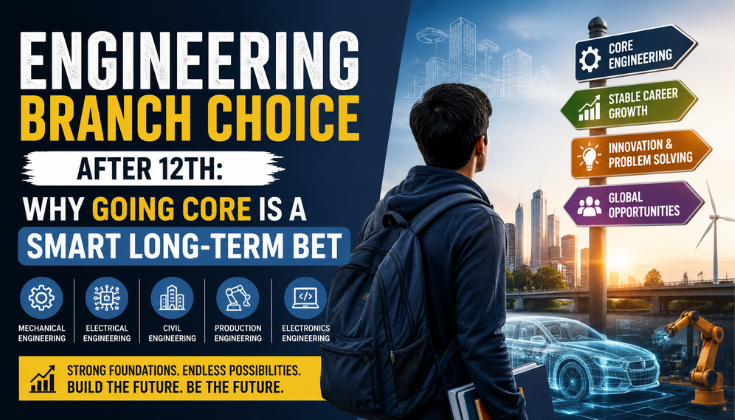
Engineering Branch Choice After 12th: Why Going Core is a Smart Long-Term Bet
“Trends may change, but fundamentals stay forever.”
Every year, after completing Class 12, lakhs of students and their parents face one of the biggest career decisions:
“Which engineering branch should I choose?”
With the growing popularity of Artificial Intelligence (AI), Data Science, Software Development, and IT careers, many students believe that traditional core engineering branches like Mechanical Engineering, Electrical Engineering, Civil Engineering, and Electronics Engineering (MECE) have become outdated.
However, the reality is quite different.
If you’re thinking about long-term career growth, job stability, global opportunities, and building real engineering expertise, choosing a core engineering branch can be one of the smartest decisions you ever make.
Let’s understand why.
Why Core Engineering Branches Still Matter
Core engineering is the foundation of every modern industry. While technologies continue to evolve, the need for engineers who understand physics, design principles, manufacturing, infrastructure, energy systems, and product development will always remain.
Whether it’s an electric vehicle, an aircraft, a smart city, a bridge, or a renewable energy project, every innovation begins with strong engineering fundamentals.
1. Core Engineers Build the World
Everything around us exists because of Mechanical, Electrical, Civil, and Electronics Engineers.
These branches are not temporary trends—they form the backbone of modern civilization.
Mechanical Engineers
Mechanical engineers contribute to:
- Automotive Engineering
- Electric Vehicles (EV)
- Aerospace Engineering
- Manufacturing Industry
- Product Design
- Crashworthiness Engineering
- Durability Engineering
Electrical Engineers
Electrical engineers work on:
- Power Generation
- Smart Grids
- Renewable Energy
- Industrial Automation
- Power Electronics
- Electric Mobility
Civil Engineers
Civil engineers shape our nation through:
- Smart Cities
- Highways
- Metro Projects
- Buildings
- Bridges
- Infrastructure Development
- Public Safety
Electronics Engineers
Electronics engineers develop:
- Embedded Systems
- IoT Devices
- Sensors
- Consumer Electronics
- Communication Systems
- Automation Technologies
No matter how technology changes, industries will always require engineers capable of designing safe, reliable, and efficient physical systems.
2. Sustainable Careers, Not Seasonal Jobs
Many software and IT jobs offer attractive starting salaries.
However, recent years have also shown us:
- Market saturation
- Large-scale layoffs
- Rapid technology shifts
- Increased competition
Core engineering offers something different.
It provides stable, sustainable, and long-term career opportunities across multiple industries.
When core engineering is combined with modern technical skills like:
- Computer-Aided Engineering (CAE)
- Python Programming
- Artificial Intelligence
- Simulation Technologies
engineers become highly valuable professionals.
Core engineering doesn’t simply prepare students for their first job.
It builds a lifelong profession.
3. Modern Core Engineers Work with Advanced Technologies
Today’s engineers do much more than traditional drafting.
Modern engineers use advanced simulation and digital engineering tools to solve real-world challenges.
They work on projects involving:
- Vehicle Crash Simulation
- Earthquake Resistance Analysis
- Thermal Analysis
- Structural Durability
- Computational Fluid Dynamics (CFD)
- Electric Vehicle Development
- High-Speed Rail Systems
- Drone Engineering
- Smart Manufacturing
Industry-leading CAE software includes:
- LS-DYNA
- HyperMesh
- LS-PrePost
- Abaqus
- ANSYS
- Fluent
Engineers also collaborate with AI tools to improve:
- Product Design
- Performance
- Safety
- Reliability
- Optimization
These are high-demand, high-paying careers that require both strong engineering fundamentals and modern digital skills.
4. Global Career Opportunities Continue to Grow
Companies around the world continue to recruit engineers with strong domain knowledge.
Global industries need professionals who understand the physics behind engineering systems, not just software.
Major career opportunities exist in:
- Defence & Aerospace
- DRDO
- ISRO
- HAL
- Infrastructure
- L&T
- Tata Projects
- Railways
- NHAI
- Automotive
- Tata Motors
- Mahindra
- Mercedes-Benz
- Tesla
- Renewable Energy
- Solar Energy
- Wind Energy
- Smart Grid Technologies
- Robotics & Mechatronics
- Oil & Gas
- Marine Engineering
- Mining Industry
Across all these industries, Mechanical Engineering, Electrical Engineering, Civil Engineering, and Electronics Engineering graduates continue to play vital roles.
5. Core Engineering + Smart Skills = The Perfect Career Combination
At ELENO Centre of Excellence (COE), we strongly believe in one formula:
MECE + Simulation + Python + Domain Projects = Career Launchpad
Students don’t need to leave their core engineering branch.
Instead, they should strengthen it with future-ready skills such as:
- Crashworthiness Simulation
- Durability Analysis
- Thermal Analysis
- CFD Simulation
- NVH (Noise, Vibration & Harshness)
- Python Automation
- AI in Engineering
- Digital Twin Technology
Core engineering provides the foundation.
Advanced engineering tools help students build successful careers.
Why CAE Skills Are Becoming Essential
The engineering industry is increasingly adopting Computer-Aided Engineering (CAE) to reduce product development time, improve safety, and lower costs.
CAE engineers use simulation tools to test products virtually before physical manufacturing.
Popular CAE domains include:
- Crashworthiness
- Durability
- Nonlinear FEA
- Explicit Dynamics
- CFD
- Thermal Engineering
- Battery Safety
- Structural Analysis
Students who combine their engineering degree with CAE training significantly improve their employability in automotive, aerospace, defence, heavy engineering, and EV industries.
Advice for Students After 12th
Before selecting an engineering branch:
✅ Don’t choose a branch simply because it’s trending.
✅ Think about the type of engineer you want to become.
✅ Remember that every product still needs to be designed, tested, validated, and continuously improved.
✅ Engineering is a long-term career journey—not a short race.
Choose a branch that matches your interests and strengths rather than temporary market trends.
A Message to Parents
Parents play an important role in helping students make career decisions.
Instead of focusing only on salary packages or comparing with others, consider whether your child genuinely enjoys understanding machines, structures, electricity, products, or technology.
If they do, encourage them to pursue Mechanical Engineering, Electrical Engineering, Civil Engineering, or Electronics Engineering.
Support them by helping them:
- Build strong engineering fundamentals.
- Participate in practical projects.
- Learn industry-relevant tools.
- Develop future-ready technical skills.
Core engineering creates professionals who become innovators, problem-solvers, and nation builders.
Final Thoughts
Engineering has never been about following trends.
It has always been about creating solutions that improve the world.
The future will continue to need engineers who can:
- Design safer vehicles
- Build stronger infrastructure
- Develop sustainable energy systems
- Improve manufacturing
- Create intelligent products
- Solve real engineering problems
So, if you’re deciding your engineering branch after Class 12 and you’re considering Mechanical Engineering, Electrical Engineering, Civil Engineering, or Electronics Engineering, don’t think you’re choosing an old path.
You’re choosing a career built on strong fundamentals, continuous innovation, and long-term growth.
You’re not moving backward.
You’re building a smart, sustainable future—brick by brick, byte by byte.
Why Choose ELENO Centre of Excellence (COE)?
At ELENO Centre of Excellence (COE), we help engineering students bridge the gap between academics and industry by providing practical training in Computer-Aided Engineering (CAE).
Our programs focus on:
- LS-DYNA Training
- HyperMesh Training
- LS-PrePost
- Crashworthiness Engineering
- Durability Engineering
- Explicit Dynamics
- Finite Element Analysis (FEA)
- Electric Vehicle Battery Safety
- Automotive CAE
- Industry Projects
- Python for Engineers
Under the guidance of Nachiket Phadke, students gain practical exposure that prepares them for careers in automotive, aerospace, defence, EV, and advanced engineering industries.
Contact Us
Nachiket Phadke
Founder – ELENO Centre of Excellence (COE)
📞 Call: +91 9881732144
🌐 Website: https://www.eleno-elc.com