
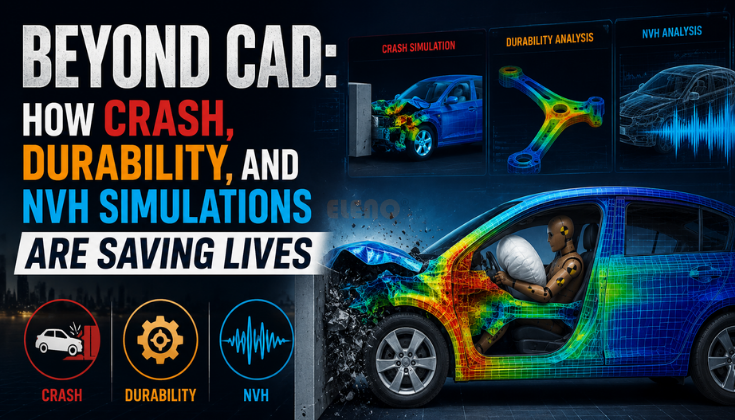
“In engineering, designing a product that looks good is not enough. A product must survive impact, last for years, and provide comfort to users. That is what truly saves lives.”
Introduction: CAD Is Just the Beginning
Many engineering students start their journey by learning CAD (Computer-Aided Design). CAD helps engineers create 3D models and visualize products before manufacturing.
But an important question remains:
- Will the product survive a crash?
- Will it perform well after years of use?
- Will it provide a comfortable experience to users?
This is where CAE (Computer-Aided Engineering) becomes essential.
Today, Crash, Durability, and NVH (Noise, Vibration, and Harshness) simulations are helping engineers build safer, stronger, and more reliable products.
These simulations are not just engineering tools—they are technologies that help save lives.
CAD Creates the Shape. CAE Makes It Safe.
Imagine designing an electric scooter.
It looks modern, lightweight, and attractive.
But what if:
- The frame breaks during an accident?
- The battery casing develops cracks over time?
- The vehicle produces excessive vibration and noise?
A good design is not only about appearance. It must also be safe, durable, and comfortable.
That is why engineers use CAE simulations to validate designs before manufacturing.
1. Crash Simulations: Designing to Protect Human Lives
During an accident, every second matters.
Crashworthiness simulations help engineers understand how a product behaves during impact and how it can protect passengers.
Crash simulations help engineers:
- Study energy absorption during collisions
- Design effective crumple zones
- Optimize airbag and seatbelt performance
- Meet global safety standards
Common crash scenarios include:
- Frontal impact
- Side impact
- Rear impact
- Pedestrian protection
- Child seat safety
- Vehicle-to-barrier collisions
Engineers use advanced software like LS-DYNA to perform these simulations.
At ELENO Centre of Excellence, engineers are trained on real-world crash projects that directly contribute to vehicle safety.
2. Durability Simulations: Building Products That Last Longer
A product should not only work on the first day. It should continue performing safely for years.
Durability simulations help engineers predict long-term performance.
Durability analysis helps identify:
- Fatigue failure due to repeated loading
- Weld and joint weaknesses
- High-stress regions
- Structural degradation over time
Industries that heavily depend on durability simulations include:
- Automotive
- Railways
- Aerospace
- Heavy equipment
- Consumer products
Engineers use tools such as Abaqus, nCode, and OptiStruct to virtually test millions of loading cycles before a product reaches customers.
This reduces:
- Physical testing costs
- Product failures
- Warranty claims
3. NVH Simulations: Engineering Better User Comfort
A vehicle may be safe and durable, but users will still reject it if it creates excessive noise and vibration.
NVH stands for Noise, Vibration, and Harshness.
NVH simulations improve overall driving experience and product quality.
NVH simulations help engineers:
- Reduce cabin noise
- Minimize vibration
- Improve ride comfort
- Reduce wind and road noise
- Enhance product quality perception
Popular tools used for NVH analysis include:
- Actran
- Ansys Sound
- LMS Virtual.Lab
- HyperMesh
Today, comfort is no longer a luxury. It has become an industry expectation.
Why CAE Is Extremely Important for India
India has unique engineering challenges.
Engineers must design products that can handle:
- Rough road conditions
- Heavy loading situations
- Unpredictable accidents
- Long product life cycles
This is why Indian manufacturers must adopt CAE-driven design approaches.
The focus should not only be on launching products quickly but on launching products that are safe, reliable, and long-lasting.
At ELENO COE, we aim to create engineers who design with responsibility and purpose.
The Future of Engineering: CAE First, CAD Later
Leading global companies are changing their design approach.
Instead of designing first and testing later, they are using CAE from the beginning.
Modern engineering companies:
- Perform crash, durability, and NVH simulations early
- Identify design risks faster
- Improve CAD designs using simulation data
- Save time, material, and cost
- Build safer products
Simulation-driven engineering is becoming the future.
A Message for Students, Parents, and Colleges
For Students
Learning CAD is a good start, but do not stop there.
Learn how to simulate, analyze, and validate designs.
That is where real engineering begins.
For Parents
Encourage students to pursue core engineering branches such as:
- Mechanical Engineering
- Civil Engineering
- Electrical Engineering
- Electronics Engineering
Specialized domains like Crash, Durability, and NVH simulations offer future-ready career opportunities.
For Colleges
Engineering education should move beyond creating models and assemblies.
Students should learn to test, validate, and improve their designs using CAE tools before manufacturing.
Learn to Design for Safety, Reliability, and Comfort
At ELENO Centre of Excellence (ELENO COE), we provide advanced industry-oriented training in:
- Crashworthiness Simulations
- Durability & Fatigue Analysis
- NVH Simulations
- Industry Projects
- Hands-on Learning
- Expert Mentorship
We believe engineering is not just about creating products.
It is about protecting lives.
Frequently Asked Questions (FAQs)
What is the difference between CAD and CAE?
CAD is used to create product designs and 3D models, while CAE is used to analyze, validate, and improve product performance before manufacturing.
What are Crash, Durability, and NVH simulations?
These are engineering simulation methods used to improve product safety, lifespan, and user comfort.
Which industries use CAE simulations?
Automotive, aerospace, railways, defense, heavy equipment, consumer products, and electric vehicle industries.
Which software tools are commonly used?
Popular CAE tools include LS-DYNA, Abaqus, HyperMesh, OptiStruct, nCode, Actran, and LMS Virtual.Lab.