
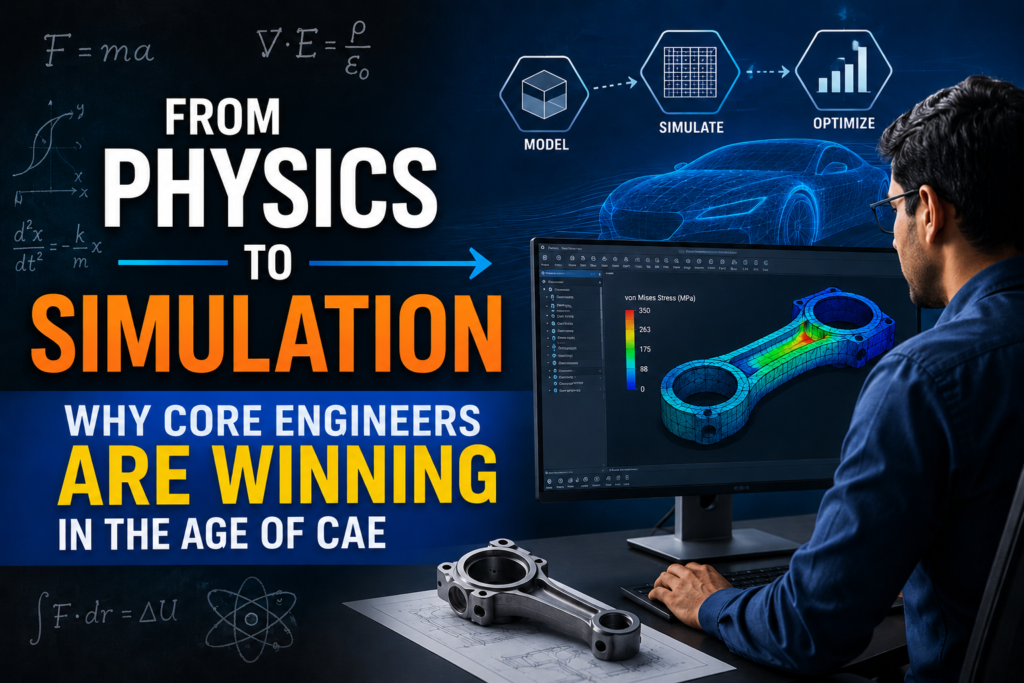
From Physics to Simulation: Why Core Engineers Are Winning in the Age of CAE
“If you understand physics, you can simulate the future. If you rely only on tools, you’ll always chase it.”
Today, whenever students discuss careers, the conversation quickly shifts towards Artificial Intelligence, Data Science, Software Development, and Automation. Many students pursuing Mechanical, Civil, Electrical, and Electronics Engineering start questioning whether their branch still has value in today’s industry.
Parents ask:
“Are core engineering jobs still available?”
Students wonder:
“Should I switch to IT?”
The answer becomes clear when you step inside an automotive R&D center, a crash lab, a manufacturing facility, or an aerospace development center.
You’ll find one common thing everywhere:
Engineering Simulation is driving product development.
And behind every successful simulation is an engineer who understands physics.
The rise of Computer-Aided Engineering (CAE) has not reduced the importance of core engineering. In fact, it has increased it.
Simulation Doesn’t Replace Physics. It Depends on Physics.
Many people think simulation software does all the work.
They see powerful tools like:
And assume that learning software alone is enough to build a successful CAE Career.
But let’s think about it.
Can software decide whether a material model is correct?
Can software identify whether a boundary condition makes engineering sense?
Can software tell you whether a result is physically impossible?
No.
The software only solves equations.
The engineer must understand the physics behind those equations.
That’s why we always tell students at ELENO COE:
“A simulation is only as intelligent as the engineer who creates it.”
The Real Foundation of CAE Careers
Before there was simulation, there was physics.
Before there was LS-DYNA, there were Newton’s laws.
Before there was Finite Element Analysis (FEA), there was mechanics.
Every engineering concept ultimately comes back to fundamental physical principles.
When students study:
- Force
- Stress
- Strain
- Motion
- Vibration
- Heat Transfer
- Fluid Flow
- Material Behaviour
They are learning how the real world behaves.
Simulation simply predicts that behaviour using mathematics and computing power.
This is why engineers with strong fundamentals often become the best Simulation Engineers.
They don’t just run software.
They understand what the software is trying to represent.
Why Core Engineers Have a Huge Advantage
One of the biggest myths about CAE is that it is a software job.
It is not.
Companies hiring for Automotive CAE, Crashworthiness Analysis, Durability Analysis, and Engineering Simulation roles look for engineers who can:
✅ Understand real-world physics
✅ Apply meaningful boundary conditions
✅ Select appropriate material models
✅ Interpret results correctly
✅ Identify modelling errors
✅ Recommend design improvements
✅ Solve engineering problems
These skills come from engineering fundamentals.
This is exactly why Mechanical, Civil, Electrical, and Electronics engineers continue to play a critical role in modern product development.
The software may change.
The physics never changes.
A Real Industry Lesson
Let me share a simple example.
A young engineer was assigned a crash simulation project.
The model was built.
The mesh looked good.
The solver completed successfully.
No software errors appeared.
Everything seemed perfect.
But when the results were reviewed, something was wrong.
The simulation showed a physically impossible response.
The engineer had applied incorrect constraints without understanding how forces travel through the structure.
The software did exactly what it was asked to do.
The mistake came from the engineer’s lack of understanding of deformation mechanics and load paths.
This happens more often than students realize.
That is why companies don’t hire people simply because they know how to click buttons inside software.
They hire engineers who understand the science behind the simulation.
How CAE Is Transforming Industries
Today, Computer-Aided Engineering (CAE) is at the heart of product development across industries.
The demand for skilled CAE Engineers continues to grow because companies want faster development, lower costs, and better-performing products.
Let’s look at some examples.
Automotive Industry
The automotive industry relies heavily on:
- Crash Simulation
- Crashworthiness Analysis
- Durability Analysis
- Vehicle Safety Studies
- Pedestrian Protection
- Structural Optimization
Before a vehicle is physically tested, engineers use LS-DYNA and other CAE tools to predict how it will behave during impact.
A strong understanding of mechanics, material behaviour, and energy absorption is essential.
Aerospace Industry
Aircraft and spacecraft must operate in extreme conditions.
CAE helps engineers perform:
- Impact Analysis
- Fatigue Studies
- Thermal Analysis
- Structural Dynamics
- Vibration Analysis
Behind every simulation is an engineer applying core engineering principles.
Civil Engineering
Modern infrastructure projects use simulation to study:
- Earthquake Resistance
- Wind Loading
- Structural Stability
- Blast Loading
- Bridge Behaviour
Simulation helps engineers make structures safer and more reliable.
Manufacturing Industry
Manufacturing companies use Engineering Simulation for:
- Metal Forming
- Process Optimization
- Thermal Distortion Analysis
- Product Validation
This reduces development time and improves quality.
Defence and Space
Some of the most advanced CAE applications are found in defence and space programs.
Engineers perform:
- Hypervelocity Impact Analysis
- Thermal Shock Studies
- Blast Simulations
- High-G Loading Evaluations
These applications require deep knowledge of physics and engineering fundamentals.
Why Learning Software Alone Is Not Enough
Many students start learning CAE by focusing only on software.
They learn commands.
They learn menus.
They learn workflows.
But they struggle during interviews.
Why?
Because interviewers don’t only ask software questions.
They ask:
- Why did you choose this boundary condition?
- Why did this component fail?
- What material model did you use?
- Why is the stress concentration occurring here?
- How would you improve the design?
These questions cannot be answered through software knowledge alone.
They require engineering thinking.
And engineering thinking comes from strong fundamentals.
The Growing Demand for Simulation Engineers
As industries move towards digital product development, the demand for engineers with simulation skills continues to increase.
Companies are actively hiring professionals skilled in:
- LS-DYNA
- HyperMesh
- Crashworthiness Analysis
- Finite Element Analysis (FEA)
- Explicit Dynamics
- Engineering Simulation
- Automotive CAE
- Durability Analysis
Engineers who combine domain knowledge with CAE skills often find opportunities in:
- Automotive OEMs
- Tier-1 Suppliers
- Aerospace Companies
- Manufacturing Organizations
- Defence Programs
- Research and Development Centers
The future belongs to engineers who can combine physics with simulation.
How ELENO COE Builds Industry-Ready CAE Engineers
At ELENO Centre of Excellence (COE), we believe students should first understand engineering and then learn software.
Our objective is not to create software operators.
Our objective is to create confident engineers who can solve real industrial problems.
That’s why our CAE Training programs focus on:
Engineering Fundamentals
Students strengthen their understanding of:
- Mechanics
- Material Behaviour
- Structural Analysis
- Engineering Physics
Industry Software
Students learn:
- LS-DYNA Training
- HyperMesh Training
- LSPP
- Crash Simulation Techniques
Real-World Projects
Students work on industry-oriented applications involving:
- Crashworthiness Analysis
- Automotive CAE
- Durability Studies
- Explicit Dynamics
Career Development
Our programs help students prepare for:
- CAE Jobs
- Simulation Engineer Roles
- Automotive Industry Opportunities
- Product Development Careers
The goal is simple:
Think like an engineer. Simulate like a professional.
A Message to Students
If you are studying Mechanical, Civil, Electrical, or Electronics Engineering, don’t underestimate the value of your branch.
Your engineering fundamentals are your biggest strength.
Learn:
- Physics
- Mechanics
- Material Behaviour
- Engineering Principles
Then combine them with modern CAE tools such as LS-DYNA and HyperMesh.
This combination can open doors to exciting careers in Automotive CAE, Crash Simulation, Product Development, and Engineering Simulation.
A Message to Parents
Technology changes every few years.
Engineering fundamentals remain valuable for a lifetime.
The industry will always need engineers who understand how products behave in the real world.
Encourage students to build strong fundamentals and develop practical CAE skills.
That combination creates long-term career opportunities.
The Future of Engineering Belongs to Those Who Understand Physics
The age of CAE is not replacing core engineering.
It is giving core engineers a powerful new platform.
Today, engineers can simulate crashes before vehicles are built.
They can predict failures before products are manufactured.
They can optimize designs before prototypes are created.
But all of this is possible because of one thing:
Physics.
Those who understand physics know what to simulate.
They know why to simulate.
And most importantly, they know how to improve the designs that shape our world.
That is why the future of Computer-Aided Engineering belongs to engineers who combine strong fundamentals with modern simulation skills.
And that is exactly the kind of engineer ELENO COE is committed to building.
About ELENO Centre of Excellence (COE)
ELENO COE is a leading CAE training institute focused on developing industry-ready engineers through practical learning, real-world projects, and expert mentorship.
Our specialized programs include:
- LS-DYNA Training
- HyperMesh Training
- Crashworthiness Analysis
- Automotive CAE
- Finite Element Analysis (FEA)
- Engineering Simulation
- Explicit Dynamics
With placement-focused learning and industry-relevant projects, ELENO helps engineers build successful careers in Computer-Aided Engineering.
📞 Contact: +91 9881732144
🌐 Website: www.eleno-elc.com